Benefits of Carrying your Baby in a Sling
The benefits of using a sling or carrier with your baby are numerous and can be equally positive for all the members of the family, not just baby and parents, but older brothers and sisters, grandparents, and other relations too. Here are some of the many advantages:
Sheer convenience
With your baby in a sling you have two hands available while giving your baby the closeness and attention he needs. You’re able to play with older siblings, fix yourself food and drink, and get everyday tasks done without putting down a baby who wants to be cuddled.
Getting out and about with your baby in a sling is so much simpler. Anywhere your feet can take you your baby can go too, happy and content to view the world from the safety of your body. There’s no need to wait for lifts, or avoid stairs and escalators, rough terrain or stiles.
Public transport becomes much easier to navigate. There’s no more waiting in the rain because the buggy spaces on the bus are already full. Trips to the supermarket are unencumbered by carrying a car seat or a pushing a buggy, and there’s plenty of room to cram shopping in the boot when you don’t have to find room for the pushchair.
If you use a sling for an older, walking baby, you are able to have both hands free to guide him. A sling in your bag is the perfect solution for toddlers with tired legs or in need of a nap, and you have no need to take out an empty pushchair ‘just in case’.
Everyday activities at home and away are easier using a sling or carrier.
Bonding, development and close contact
All babies crave close contact with their carers. Using a sling or carrier is a way to give that closeness and security to your baby. Babies in slings have been shown regularly to cry up to 40% less, making life easier for you and much less stressful for them. Instead of crying, they spend more time in a ‘quiet alert’ state, which is the best time for babies to learn, and sleeping, which is the best time for them to grow.
Using a sling or carrier helps your baby to develop and can soothe her effortlessly when she is sick, teething or tired. As your baby grows, using a sling can provide excellent stimulation and learning opportunities purely by giving her the opportunity to observe your day to day activities. Allowing your baby to be close to you much of the time can make it much easier on both of you when you do need to put her down because you have already fulfilled her need for security.
Physical benefits for the parent
For the parent who uses a sling, the need to hold the baby one-handed or balanced on the hip while getting on with everyday tasks is vastly reduced. The weight of the baby is spread over your torso, reducing the strain caused by lopsided carrying in arms. Constant lifting of a baby in order for him to see is not necessary as they already have a view from near your eye-level.
Piggybacks and carrying the baby on your shoulders can cause strain and injury. Using a sling gives the same effect but allows for proper weight distribution.
Breastfeeding mothers find the close physical contact with their baby can stimulate milk production and a sling can allow for easier, discreet breastfeeding. Bottle feeding is also simpler when out and about, as you can hold your baby close to you without straining your arms.
Physical benefits for the baby
Using a sling helps babies learn to regulate their own temperature and breathing as they are stimulated by the parent’s own body cycles. Using a sling in an upright posture can help babies’ digestion, and enable them to bring up wind. The massaging effect of being tummy to tummy with a parent can help with cases of reflux, colic, trapped wind and constipation.
Time spent upright in a sling has the same effect on a baby’s muscles as ‘tummy time’, encouraging them to develop the core strength they need to achieve physical milestones, from holding up the head to walking. It also acts as a preventative measure against ‘flat-head syndrome’ as the head is not lying on anything flat, and hip dysplasia, if the sling is positioned correctly.
Types of Slings – A Brief Guide
A sling should be on every new parent’s wish list. It is the closest thing to an extra pair of hands you are likely to come across. They are infallible for soothing a grizzly or colicky infant, keep the baby happy while letting you get on with essential chores, and are invaluable while out and about, whether travelling on public transport, negotiating steps, escalators and busy shops, or on country walks.
So many slings are available today we are spoilt for choice, but the selection is so wide it can be bewildering. When choosing a sling it is best to consider when and how you plan to use it, who else will be using it, and whether you have the patience to master one of the trickier types. Or you could buy more than one for different purposes. But be warned, they are addictive and you might find yourself building up a collection!
Wraps
Wraps are very long lengths of material which are wrapped around the wearer and baby, and tied. They are very versatile, allowing a complete range of carries on one or both of the wearer’s shoulders, can be used by different sized adults and are very comfortable for long periods.
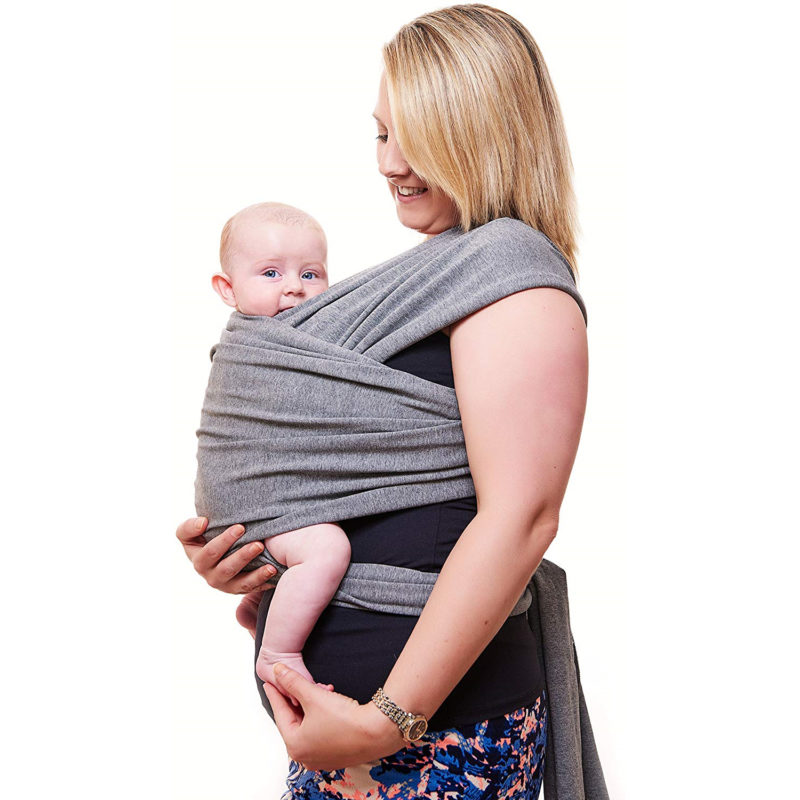
amazon.co.uk
Stretchy wraps
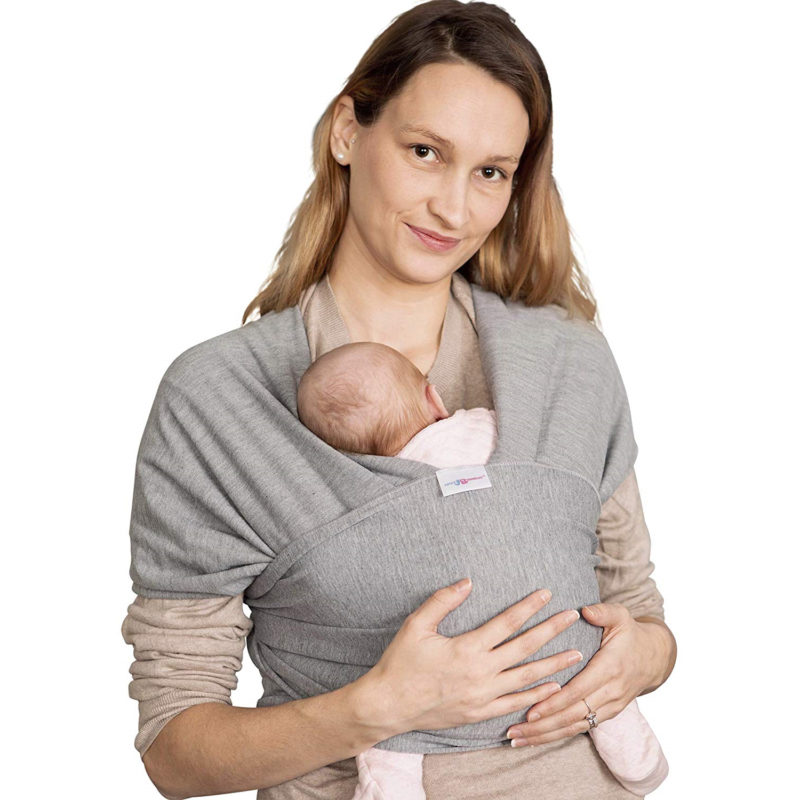
Stretchy wraps are generally pre-tied which makes them very easy to use for those new to slings. Due to their stretch most users find that they want to move on to another carrier around 6 months.
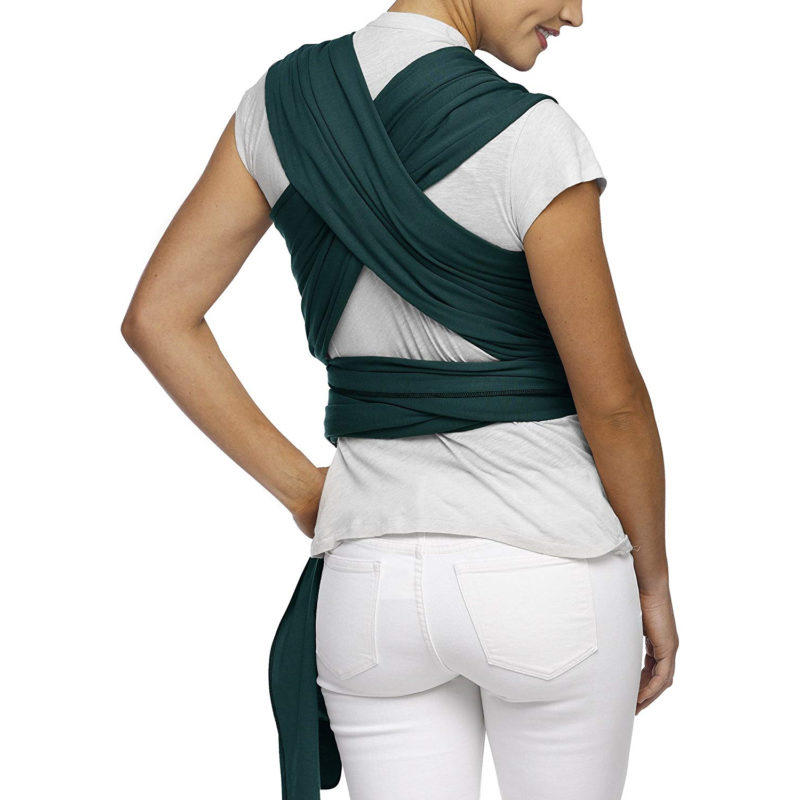
amazon.co.uk
German Style Woven / Woven wraps
These wraps have a diagonal weave which many people find adds to the comfort when carrying a child. They are called German Style Woven or GSW because they first became popular in Germany. Nowadays they do not necessarily come from a German company.
Gauze wraps
Gauze wraps have a straight weave which usually makes them cheaper. Often they are thinner as well making them ideal for summer.
SPOC wraps
SPOC stands for Simple Piece Of Cloth. This indicates that the piece of cloth used was not woven with the specific purpose of being a baby carrier. It is possible to make a SPOC yourself by hemming a long piece of material.
Hybrid wraps
Some wraps have qualities of both a stretchy and a woven wrap which is why they are referred to as Hybrid wraps. It may for example be possible to back carry with a hybrid wrap which has a large amount of stretch.
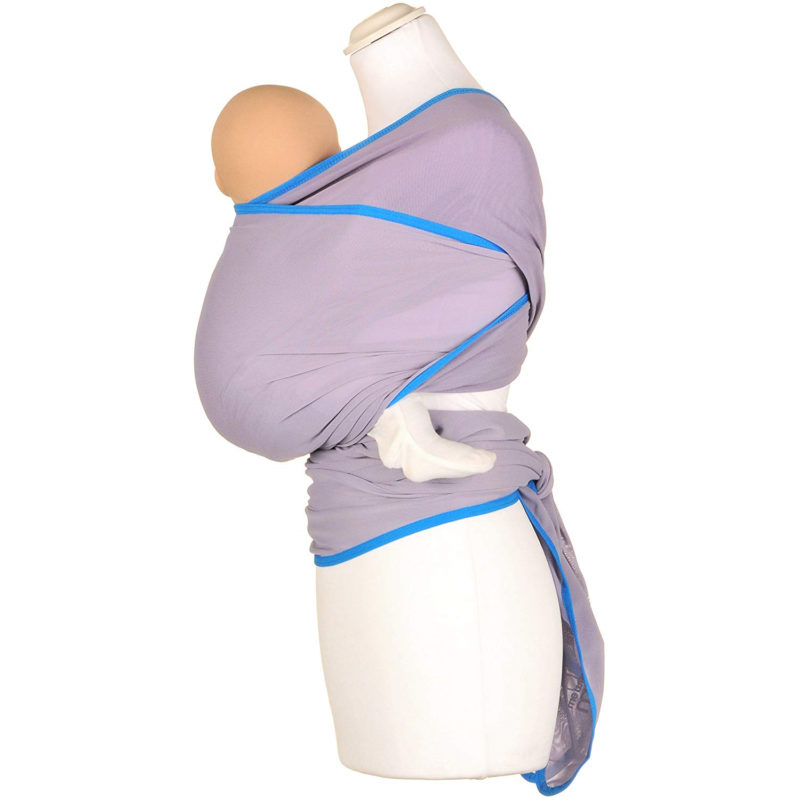
amazon.co.uk
Soft Structured Carriers
Soft structured carriers fasten with straps and buckles and often have a padded or structured waist. In design they are based on Asian Style Carriers like the Mei Tai. They can be used on the wearer’s front or back, and, as the weight is distributed across both shoulders, they are very comfortable for long periods.
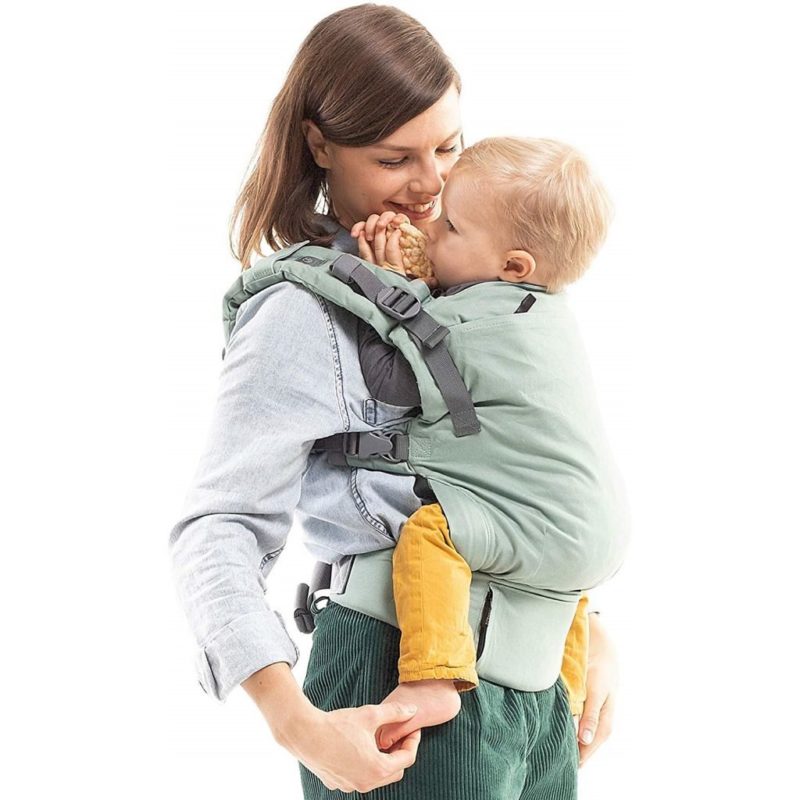
amazon.co.uk
They are quick and easy to put on, but if the carrier is to be shared with a different sized adult you will have to learn to adjust the fitting of the buckles. Many models come with sleep hoods. They are suitable for babies from about three-months-old until well into toddlerhood although some makes have the ability to adapt to use with a smaller baby.
Some makes come in a beautiful range of fabrics, while others are more utilitarian in style.
Mei Tais
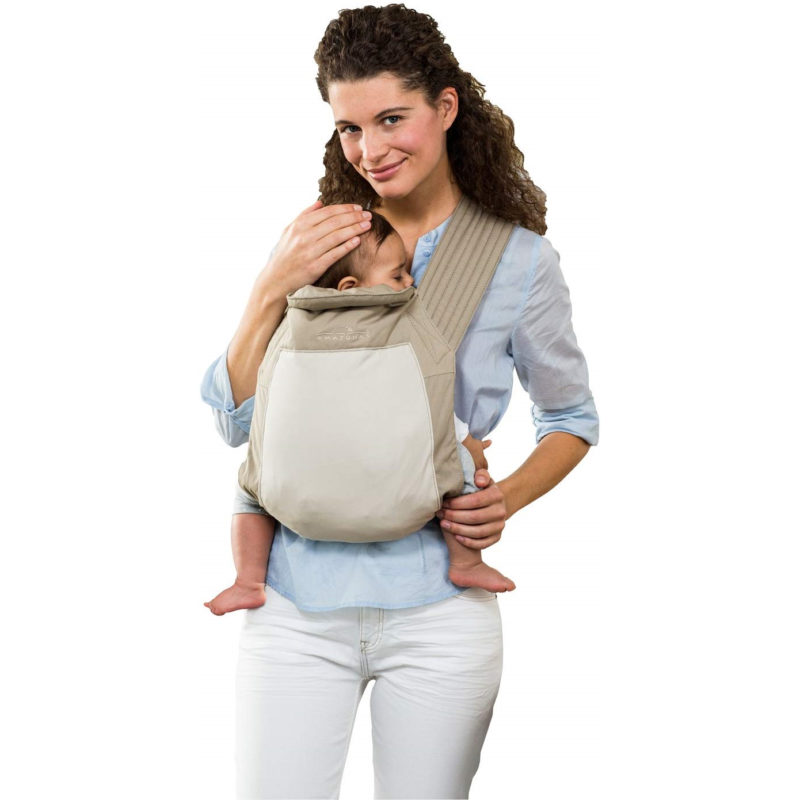
Mei Tais are a traditional type of Asian baby carrier. They consist of a shaped piece of fabric to fit around the baby’s body with long straps at the base and the top. The lower pair of straps tie around the wearer’s waist and the top pair are crossed over the wearer’s body, brought forward to cross over the baby’s bottom and then tied around the wearer’s waist.
amazon.co.uk
Mei tais can be used on the wearer’s front or back, and, as the weight is spread across both shoulders, they are very comfortable for long periods and with heavier babies. They can be used by different sized adults without any adjustments, and are suitable for babies with good head control until well into toddlerhood.
Most mei tais come in a sumptuous range of fabric designs but plainer ones are available if that is what you prefer. They are very easy to use and often it is possible to order a custom design with a fabric of your choice.
Mei tai pricing depends on many factors. From the very popular widely available brands with a reasonable price tag to the full custom designs using luxury fabrics and individual finishes with a price tag to match.
Ring Slings
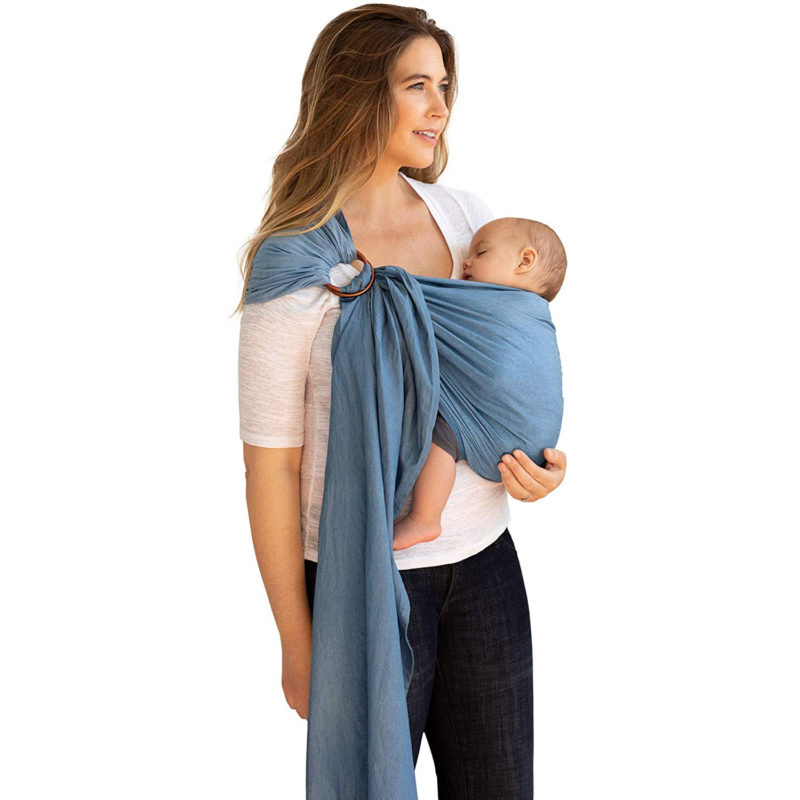
A ring sling is a length of fabric with two rings sewn in at one end. The other end of the material is threaded through the rings like a belt to form a pocket for the baby with a tail of fabric hanging down. Ring slings are worn over the shoulder like pouch slings and have the same variety of carries, but the rings allow for adjust-ability in different positions and for different wearers.
The baby can be carried easily on your hip or on your front.
amazon.co.uk
They come in a range of fabrics, can be padded or unpadded, and some are frankly stunning for special occasions. Learning to adjust the rings for a comfortable fit can take a bit of practice – the rings are meant to sit just below your collarbone. And, like the pouch slings, they place all the weight on one shoulder.
Ring Slings have a variety of different shoulders. Finding out which shoulder style works for you can be key in finding a comfortable ring sling.
Pouches
A pouch sling is a simple tube of fabric with one half folded inside the other to form a pocket which is worn across the body like a sash. It allows a baby to be carried in a variety of positions, lying across the body in a cradle position, upright facing in, and sitting on the parent’s hip. It can be used from birth to toddlerhood by altering the carry position, and allows an older baby to have arms and legs outside the sling.
amazon.co.uk
Pouches are made in a variety of materials from cuddly fleece to cool linen and are quite cheap in comparison to other types of sling. They are also quick to master, easy to put on in a hurry, and pack up small to carry in a change bag. Unfolded, they can be used as car seat or buggy blankets, especially the fleece types. They place all the weight on one shoulder, which can get tiring for long periods with an older baby.
As pouches are sized it may not be possible to share one pouch with someone else.
Warning About Bag-Style Baby Slings
Bag-style slings, as their name suggests, resemble large shoulder bags with a deep pocket for the baby to lie or sit in, an elasticated opening and a strap designed to be worn over the sling user’s shoulder, or across the body.
We recommend you stay well clear of such products!
These slings have been implicated in far too many infant deaths by suffocation. They have been directly linked to three deaths of very young babies across the USA in the past two decades, and 11 more infant deaths are under investigation. The sling using community, alerted by the pioneering research work of sling safety campaigner M’liss Stelzer, has been actively warning against their use for some time.
The warning has now been heeded in the USA, where the US Consumer Product Safety Commission (CPSC) has raised the alarm about the safety of bag-style slings. One brand is now the subject of a product recall and it is to be hoped other manufacturers producing this type will be encouraged to withdraw them from sale in the future.
While bag-style slings may appear at first sight similar to pouches and ring slings, the pocket for the baby to sit or lie in is far deeper. The shape of the bag makes it very easy to place the baby in a curved position with his chin tucked against his chest, constricting his airways and giving rise to the risk of positional asphyxia.
The risk is heightened by the depth of the pocket as the fabric may cover the baby’s face, and the design may compress his face against the sling wearer’s body, further increasing the likelihood of suffocation. As the pocket is so deep, and the sling is designed to be worn low on the body, the sling user may not be aware of any distress signals from the baby until it is too late.
In a true pouch or ring sling the pocket formed by the fabric is far shallower, the sling is positioned high on the user’s body, and the baby’s face should be visible and close to the sling wearer’s face at all times.
If you have or are given a bag-style sling we urge you not to use it, sell it or even give it away, unless it be to be for the purpose of demonstrating its dangers. Much the best thing you could do would be to destroy it by cutting it up to ensure it can never be used to carry a baby.
Sadly, the announcement by the US CSPC has caused confusion in some quarters, with some reports believing the warning extends to all slings. This is not so, and traditional pouches, ring slings, wraps, mei tais and soft structured carriers are, and always have been safe for use with your baby so long as you follow the guidelines on correct positioning.
Broadly speaking, you should keep your baby snug to you, close enough to kiss her head, with her chin clear of her chest to avoid any constriction of her airways, and her back fully supported. Her nose and mouth should be free of any obstruction.
Baby Sling Resources
As with everything you buy for your baby a sling is something that you need to consider very carefully. Research is especially important with a product which is going to bear the weight of a child. Here are a few important points to bear in mind when deciding what and where to buy:
When buying second hand, make sure you ask about the condition of the item, and where possible, buy a brand that you have heard recommended before.
- When something appears to be too good to be true it often is. Make sure you are not buying an inferior quality counterfeit item by purchasing from a reputable retailer.
- A good seller will never mind you asking questions about the safety of a product or their liability insurance.
- Before using a sling make sure that it looks secure. It should have no holes, loose threads or stitching coming undone.
- If you have a sling and you are unsure of its safety ask someone else to check it over before using it. Your child is precious, and although most slings are safe and made by people who know what they are doing, as with any products you use for your child, you need to be certain. It is better to be safe than sorry.
Internet retailers selling a variety of slings and sling accessories:
Sling makers retailing their own brand of slings:
- Calin Bleu
Woven wraps, stretchy wraps. - Kari Me Baby Carriers
Stretchy wraps. - Lifft Slings
Pouches. - Oscha Slings
Woven Wraps, made in Scotland - Pouchlings
In stock ring slings, custom pouches and ring slings, custom wrap to ring sling conversions. - Rose and Rebellion
Soft structured carriers. - Sa-Be Babywear
Stretchy Wraps
Common Questions
Before you start using a sling you are almost certain to have some questions. They may be worries about your baby’s ability to breathe in a carrier, or doubts about everyday practicalities, such as coping with the weather.
Below are questions that crop up repeatedly, together with a selection of answers and advice from a group of experienced sling users.
I carry my nearly three-year-old still – so I would say for as long as you like and for as long as it feels comfortable.
I still carry my two-and-a-half-year-old every day. She likes to walk a lot of the time, but I bring a ring sling for when she gets tired. If she is sleepy we use a long woven wrap in a back carry. Really we use slings at the same time as many people use a pushchair for their toddler.
Many slings can be used by people of very different sizes. This is a Beco soft structured carrier and adjusts to fit my strapping 6’2″ hubby and myself – a petite 5’3″
I am 5’3″ and my husband is 6’4″ and he shares many of my slings. We also use them for both our children – although there is almost a three year age gap
I carry my nearly three-year-old still – so I would say for as long as you like and for as long as it feels comfortable.
I still carry my two-and-a-half-year-old every day. She likes to walk a lot of the time, but I bring a ring sling for when she gets tired. If she is sleepy we use a long woven wrap in a back carry. Really we use slings at the same time as many people use a pushchair for their toddler
My son was six weeks premature, and weighed only 4lb 10oz. I also had an older (10 month) baby to look after at the same time. I used a stretchy wrap to carry my newborn, and it was a godsend!
As well as keeping my hands free so I could attend to my older son and get on with household chores, my ‘preemie’ found it hugely comforting being cuddled in close to me, and he would usually fall asleep as soon as I wrapped him up.
I also used my wrap for breast feeding, and for ‘skin to skin’ contact with him – which is highly recommended for premature babies and shown to help them thrive.
I also used a ring sling with him. This was handy as it meant I could pop him in and out as needed, and it was also great for breast feeding in public as I could use the fabric tail to feed more discreetly.
I find that getting people to try out slings is the best way to get them to understand. Today my Dad was round to help out with the twins. He’s always found the whole sling thing a bit weird.
I suggested going for a walk along a country path where we couldn’t take the pushchair – obviously necessitating a sling! He wasn’t keen but agreed. I put him in my most manly wrap conversion and we had a lovely walk.
I didn’t even ask him what he thought about it. Then he just commented afterwards how lovely he’d found the experience, how nice it was to be so close to them and get to see all their expressions, have them snuggle up for a sleep, and most of all how comfy and easy it was!
I think my family found it a bit odd at first but with time most people will see the benefits of it. Maybe arrange a family day out to somewhere that involves a lot of steps or climbing – they’ll soon be glad you have a sling with you and not a buggy!
You will see a difference in your baby. You’ll have your hands free to get on with housework. You’ll be in and out of shops before the mama with the pushchair has got in the door.
You’ll be hopping up and down escalators in the shopping centres. You’ll have a happy contented child, that you can feel and see, and what’s more important than that!?
When would you want to put your baby down? In a coffee shop you’d use a high chair or normal chair, depending on the baby’s age, or if they’re asleep, you’d keep them in the sling so you could enjoy your coffee in peace!
I hardly ever found a need to put my baby down, I snuggled her whilst I ate and even managed to spend a penny still carrying her. Trying on clothes is not easy so I tended to buy online and return the ones that were the wrong size.
I don’t! I just hold her on my lap if I’m out to eat, or if she’s asleep I put a napkin on her head and eat over her!
I put her on my lap, or lying on the sling. This was a bit of a problem when we went to the beach once, and she was all hot and didn’t want to be stuck on my lap, but I couldn’t put her on the pebbles. But then it was probably too hot to be at the beach anyway.
I’ve never been one for huge baby bags, and taking stacks of stuff with us. I just use a large shoulder bag. Rather than taking packs of wipes, l just fill a little Tupperware container with wipes. And I take just one bottle of water which does for us both.
Breastfeed if you can, to save on bottle paraphernalia. And get a shopping trolley on wheels.
I had a large single shoulder bag which held a few nappies and a change of clothes. I gave up on a handbag though, and put all I needed in the same bag. A rucksack was also a good option.
I found I needed less stuff than I thought I would, and when doing front carries, a small rucksack or a 2 stringed boot bag on my back was fine. These days I fill up my pockets, and use a messenger style bag or a trolley.
I actually do one of two things. Either I carry a small handbag with a nappy, small bag of wipes, and a spare sleepsuit in it. Or if I take my wrist purse, that’s big enough for a wee bag of wipes and I tuck a nappy into the layers of the sling.
I bottle feed so I do have more paraphernalia to carry, and I do have a tendency to cart everything but the kitchen sink anyway. But a good rucksack change bag or an Onbag, which is a bag designed to be used with slings, swallows everything and still leaves me hands free for shopping bags.
I have found that my daughter’s temperature seems to follow mine. If I am too hot and sweaty she will be too.
But if I walk slowly and keep in the shade she’s fine. On the odd occasion I truly feel too hot to carry her, she probably feels the same.
Sometimes my son does get hot, but it would be the same with a pushchair. In a sling I can monitor how warm he gets, and deal with it – take off some of his clothes, go somewhere cooler, get him a drink, etc.
I have found in the summer we both get a little hot, but not too hot and there are great Solarweave and Solarveil carriers around that help protect your baby from the sun.
In the winter I am careful to keep my daughter’s head, hands and feet warm but she wears a light coat under the carrier and we are both fine.
On really hot days when we have no choice about going out I use a parasol. I’ve been very glad of it for myself, let alone the baby, and there are some wonderful traditional designs about.
Slings are just like anything else – there’s a huge variety. There are cheaper wraps, mei tais, ring slings, etc, and there are some quite expensive ones.
The cheaper ones do the job but, as with buggies, there may be some special feature or reason why you want to buy the more expensive ones. My favourite sling is one of the cheapest you can buy!
Either way, they’re still cheaper than almost all buggies or prams.
It depends what you compare them to – £40 for a new stretchy wrap may seem a lot but it would last much longer than the equivalent value of disposable nappies and it’s certainly better value than many toys.
I used to think exactly the same when I first started using a sling. It’s mostly to do with the fact that a lot of slings are handmade and not mass produced, so the time taken to make them is reflected in the price.
I have now got a few of the more expensive carriers, and they can be well worth the money.
You can get very good carriers for very reasonable prices, much less than the cost of a pushchair, and the resale value on slings is good if you find you don’t like one.
You can spend £70 on a mass-produced carrier that you can only use until the child’s weight restricts its use or it becomes uncomfortable. Lots of soft slings will last until the child is four or five so they’re an investment.
When I started looking at different makes of slings I couldn’t believe some of the prices! They were beautiful, but way out of my price range so I stuck to the cheaper ones.
Now, having tried a more expensive wrap, I understand why they are more expensive. They’re so comfortable, so supportive and very beautiful -you’d be paying way more for a pushchair with so many perks!
Many baby carriers are not commercially made. They are often made by Work At Home Mothers (WAHMs), who cannot afford to sell as cheaply as the big brands. A WAHM simply cannot compete with cheap foreign labour and mass factory production.
The love, care, time and attention that goes into these carriers is immense. The fabrics used to make such slings are also of a superior quality to those used in mass-produced carriers, and they are often fairly traded and hand woven.
Wraps may just seem like long pieces of material, but good quality woven wraps are not cheap to make. They are usually hand woven using materials of an excellent quality.
A good quality sling should be seen as an investment. It could easily see your baby through infancy to childhood. Very likely you will be able to use it for all your children and then sell it on, or even pass it down to your own children and grandchildren.
Of course! It’s just like a hands-free hug! Your baby will be very relaxed as he’s got contact with your skin and your warmth.
Slings come with complete guides for safe use and, if used correctly, yes, your baby will be able to breathe properly!
In fact, being so close to you and your heartbeat, and being able to hear your breathing, will probably help your baby regulate her own breathing and ‘remind’ her to breathe properly even when sleeping.
Yes, my babies tended to turn their heads to the side or snuggle down so they were resting on their foreheads, so they were still able to breathe even if their faces were hidden.
When my daughter was tiny I would constantly jostle or stroke her to see if she was still OK. On the rare occasions she was in her crib I hated being so far away that I couldn’t tell whether she was breathing or not.
I actually fell over the other week while carrying my son in my arms. I dropped him on the ground and twisted my ankle. Now if he had been in a sling, both of my arms and hands would have been free to break the fall
I have fallen over and my daughter was perfectly fine as I had both hands free to break the fall. It was far safer than if I had been carrying her in my arms.
I slipped on wet rocks at Hadraw Force waterfall while we were on holiday. All was fine, and I brushed the mud off and carried on. My mei tai saved the day and my daughter thought it was really funny.
I have fallen downstairs with my baby in a sling on my front. I went bump-bump-bump from top to bottom, but was able to protect him with my arms and he was fine. If I had just been holding him, then he would have fallen out of my arms.
When my other son was a baby I managed to bang the buggy into the kerb, tip it forward, keep walking and fall over on top of the buggy. He was screaming, I banged my leg on the buggy and got huge bruises – ah, if only he’d been in a sling!
Would you rather fall over with a pushchair, letting go of the pushchair and it potentially rolling into a road or ditch?
The other day I was rushing around with my daughter and coming down the stairs, I tripped and started to fall. As she was safe in the sling, I was able to put my arms out and break the fall.
Now, if that had happened while I was carrying her in my arms, I would have been unable to reach out to break my fall and my instinct would have been to curl around my baby to protect her, as anything else would mean dropping her.
Thanks to the mei tai, I didn’t plunge headlong down the stairs. This incident convinced me that I need to use my slings more than I have been, not less.
I’ve fallen over when walking with my son in the sling a couple of times and been able to use my hands to break my fall. Had I been carrying him in my arms I wouldn’t have been able to do that and it could have ended up with one or both of us injured.
Using a sling, in my opinion, has contributed to making the very confident toddler that my son now is. He knew I was always there to hug him, so that when he was ready to walk or do something else, it gave him the confidence he needed. He’d had his hugs, so was happy to go off exploring!
In my experience, most babies are clingy, in that their natural state is to want human contact and be near a heartbeat. Even little babies are able to make that need known by becoming noticeably calmer when they are held.
I think that slings are a solution to an ‘issue’ that is intrinsic to most babies, rather than the cause. With a sling, you can indulge their clinginess and have both hands free!
Interestingly, my eldest son, who was never carried in a sling, was a much more dependent baby and toddler than my youngest, who has been carried in a sling since birth.
I’ve found it to be quite the opposite. My toddler seems very outgoing and sociable to me. I think it’s because he was always at adult height, so was more involved in conversations and what was going on around him, rather than having people talk over his head while he was in a pushchair.
My first baby was rarely carried in a sling and rarely clingy. It used to freak me out that he seemed so independent and trusting from a young age. My daughter is carried or near me enough that I don’t really register whether she is clingy.
It seems that there is ever more evidence to suggest that consistent response to needs in early childhood, and being able to have as much comfort and warmth as needed, are linked to good emotional and intellectual development. So she can cling all she likes.
In my experience you can’t make a baby anything, they just are.
It may be the sling you were using didn’t suit you or you had not been shown how to use it properly, so it was uncomfortable. I am finding wraps to be very good with my newborn but never use them with the toddler, for him I tend to use mei tais.
I don’t get on at all with buckle carriers or pouches, and only very rarely now use ring slings, although at one time I used them a lot. So it can be worth trying a few different types before writing them all off.
Don’t give up yet! Many women comfortably carry their children up to the age of four or five and beyond! The key is to find the right carrier, and ensure it is used properly.
A carrier that works brilliantly with a newborn may not work as well for an older child. Conventional carriers generally don’t provide much support beyond the newborn stage.
I suspect that this may be because of the type of carrier you tried. I still carry my nearly three-year-old and she weighs over two stone! There are many carriers designed for toddlers and different ones for babies. Have another try, and see if you can find one to suit you.
I find my baby too heavy without a sling. And a baby in a sling is much lighter than humping a car seat around. The thing is, with a sling, as opposed to most commercial carriers, the baby is held close and your centre of gravity is together.
Imagine holding your handbag at arm’s length – it would feel too heavy very quickly, but the same bag held close to your body (especially hands free) would feel as light as a feather
Believe me, it’s far easier to carry a child in a sling than without one!
My four-month-old certainly feels lighter and easier to carry than being pregnant did, even though our combined weights are more than my pregnancy weight. The sling distributes the weight really well so I hardly notice it.
I’ve even carried my five-year-old home in a sling I just happened to have with me. She was really tired after a late party and wanted a piggy back, so I used a mei tai carrier which was much easier!
I have a chronic neck problem from worn vertebrae, and my neck and shoulders really ache after just a short time carrying my baby (well, toddler now) in my arms.
However, with a sling I can carry her for hours, even at the age of two-and-a-half, and I regularly go hiking across very rough terrain with no problems.
You are more likely, in my view, to hurt your back if you don’t use a sling.
No, I have found that my atrocious posture has really been helped by carrying my child. Your baby is carried close to your centre of gravity, so he or she won’t feel too heavy and the weight doesn’t hurt your back.
I carry my nearly three-year-old with no problems. She has always been carried, so I believe my strength has increased as she has grown.
I worried about this, having had back problems before pregnancy, but carrying my baby in a sling was the best thing for my back. There was much less pressure from carrying than from other baby things, including breastfeeding. I stuck to two-shoulder carries to begin with and I found it is much easier to carry your baby with a sling than without one.
I started carrying my two-and-a-half-year-old daughter in a sling because my back hurt so much trying to carry her in my arms. It spreads her weight so much better across my body and without that horrible painful twist at hip height.
Now I get to concentrate on the lovely snuggles and having a chat, instead of thinking: ‘How much longer can I manage to hold her before my back or arms give out?
My friend came round the other day wearing her daughter in a stretchy wrap. It looked really loose and low down. She said she loved carrying her little girl, but it was giving her a really sore back so she would probably have to stop soon.
I offered her a few tips on how to tighten it and another kind of carry that might be easier to get secure.
She tried this out and was just amazed at what a difference a few tweaks had made. It was suddenly really comfortable and the pain in her back was no longer there!
With a good sling, and correct positioning, carrying your baby shouldn’t be painful. If it is, check that you are using your carrier properly.
Also, it’s worth trying lots of different carriers to find one that works for you. What’s comfortable for one person won’t necessarily be comfortable for another.
In my experience, wraps are a good option if you suffer with back pain. The fabric is spread right across your back and shoulders, distributing your baby’s weight evenly.
Also, the age of the baby will affect your comfort with different carriers. There are carriers specifically designed for heavier, older babies, which provide extra support for your back, neck and shoulders.